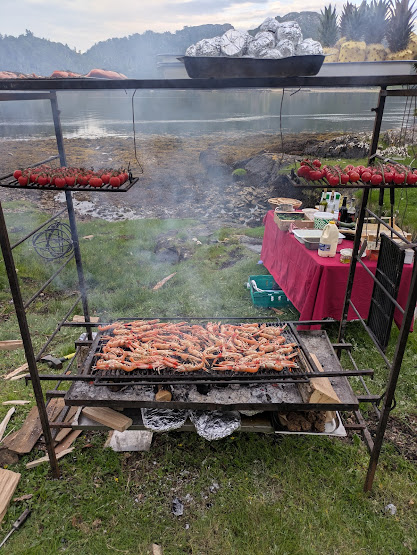
We cook on fire. We Barbecue.
But what is barbecue?
Barbecue is the catch-all term for cooking over any sort of open, raw flame, whether it’s fuelled by gas, wood, or charcoal.
To get nerdy (because we love some etymology), the word ‘barbecue’ comes from the Spanish word ‘barbacoa’, itself derived from the Arawaken ‘barabicu’ of the Caribbean. This is the term for the wooden frame for cooking meat over a fire. More nerdiness below.*
But there are so many ways of doing barbecue catering. It’s not just American. You’ve got your British sausages and burgers, Korean tables fitted with gas fires, South African braai sausages and kebabs, and everything in between.
We’re probably better described as Fire Chefs, rather than BBQ guys
Ror’s Kitchen draws on the general, modern conception of open-flame cooking, especially present in Nordic cooking today. This is an approach to cooking which centres fire as the primary source of heat.
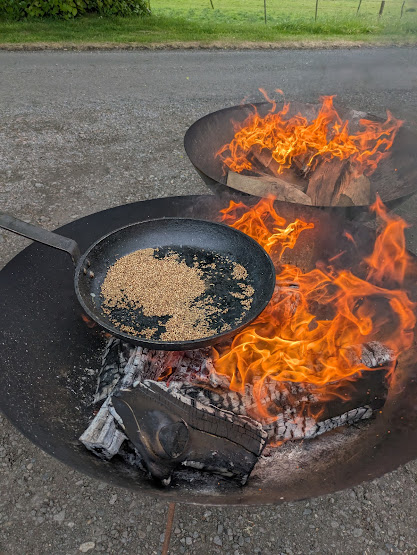
It is an elemental approach to cooking, where the fire is always visible and in use. Ingredients are necessarily cooked over the fire whether in a skillet or on a grill, hung over flame or hot smoked under cover. Niklas Ekstedt is at the helm of this movement, his dishes recalling the seasonality and connection to nature of past times, while taking cues from modern fine dining. Follow this link to find out more about this style of fire cooking.
‘I want them to experience the simplicity and purity of the ingredients, but also the complexity of flavours that reflect the rugged beauty of the Nordic landscape.’
Niklas ekstedt
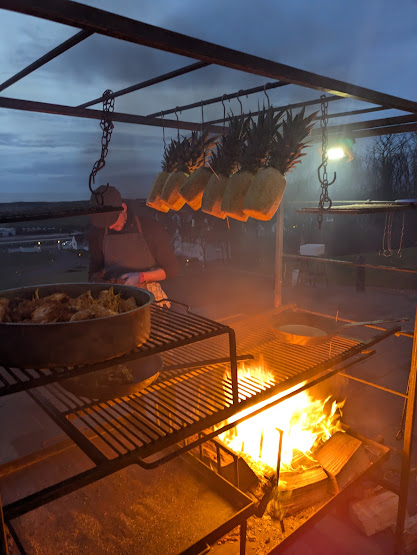
Don’t forget the theatre
Fire provides a focal point for our cooking and your event. You can’t miss it, smoke wrapping round the pit, carrying hints of what’s to come if the wind is blowing your way. Follow it, and you will find a crackling wood fire and the knowledge that you’re going to eat well.
Specific BBQ cooking cultures we embrace
Our cooking is mainly about good seasonal ingredients that we don’t interfere with too much, but there are three specific places we get most of our inspiration from.
Argentinian Barbecue, or Asado
Argentina has a deep tradition of open-flame cooking. The most famous example is ‘asado’, where big joints of meat or whole animals are splayed on a cross at a forty-five degree angle over a gentle flame for hours at a time. For more information, read our page on asado.
Ror’s curiosity was piqued by Francis Mallmann’s time on Chef’s Table. Here, he brought asado into the conversation of modern cuisine, speaking to the ceremony and primal nature of communal open-fire grilling. Here is a link to the series. When not embarking on the theatre of asado, Argentinian outdoor cooking looks like a thick, good quality steak seasoned just with salt; the sauce and salsa come into the equation when you eat it.
Middle Eastern Shawa
The Middle East is a wonderful place for fire-cooked feasts. Kebabs and flat breads, or Shawarma (more nerdism: the Arabic verb Shawa means to barbecue), and burnt vegetables charred in the embers – most famously known in baba ghanoush. We take a lot of influence from Ottolenghi in our barbecue catering, with his mixing-pot approach to spices and food culture.
To the side, you’ll find cooling sides, yoghurt dressings, chopped salads, and multiple layers of flavour in a Fattoush or a cold tomato salad. This works really well in summer wedding menus or family gatherings.
AMERICA! Or: True BBQ
American barbecue is something we have a lot of fun with at Ror’s Kitchen. This involves cooking low and slow with a technique called ‘offset cooking’. Here, you have a fire box off to the side which feeds hot air and smoke into the chamber where you are cooking your ingredients, giving them a gentle cooking and intense flavours. Then, you have dry rubs, different seasonings, sweet barbecue sauces, dredges: the lot. This approach to barbecue is ‘more is more’. This is good late-night, getting down and dirty food.
Once your meat is cooked, it’s best enjoyed with good bread, a sweet or spicy barbeque sauce, and homemade pickles. This is the ultimate formula: a hot dog goes in a bun with onions, pickle, and a sweet mustard sauce, a brisket goes in a bun or hoagie with pickles and a spicy chilli sauce. Above all, American barbecue is a conversation of bold flavours, of spice, vinegar, smoke, and lots of time.
niklas ekstedt
‘the experience and theatre are integral to what we do. Cooking over an open fire isn’t just about the end result; it’s about the process.’
A Footnote on BBQ
Ror: I was looking into the history of barbecue, and the etymology, and, with some help, I came across an amazing article below by a wonderful guy called John Shelton Reed. What followed was an interesting dialogue, which I won’t go into the details of, but we exchanged emails, and he was happy for me to quote his article. John founded a site called truecue.org, the campaign for barbecue over real wood, a really interesting guy, and passionate about good food cooked over wood.
“What could be more southern than barbecue?… Rivalled only by grits as the national dish of the South, barbecue would appear to be as southern, as indigenous, as it comes.
But, for all that southerners have made barbecue our own, the fact remains that this symbol of the South…is an import. The technique of cooking over hardwood coals or a low fire, or with smoke and indirect heat from hardwood, at a low temperature (about the boiling point of water) exists in a great many different cultures, and has from time immemorial: Europeans and Africans were both familiar with it before they arrived in the New World and found the native Indians doing it. The hogs and cattle that are the usual subjects of the enterprise were brought from Europe, as was the vinegar that goes into most sauces. The peppers that usually go in as well are a West Indian contribution. And tomatoes — well, that’s a long story, but let’s just say that they weren’t grown and eaten in colonial North America.”
* The term Barbecue was first documented by Le Moyne in the mid sixteenth century, who pictured indigenous peoples in Florida, and first appeared in English literature by William Dampier in the late 1600s, who observed a different indigenous barbecue culture in West Indian colonies.